
Static vs Dynamic Website: Choosing the Right Fit for Your Needs
13 min read
Read TimeWeb Design
CategoryJan 19, 2024
Published
In this blog
Table of Contents
Overview
If you’re here, it means you’re looking to understand everything about static vs dynamic websites for your website’s design and outlook.
The most primary questions you face during the process of figuring out details for your website would be whether static or dynamic websites serve your business better. Deciding on which type of website to go for will determine how your website’s data will be stored and displayed on a browser.
Let’s dig deeper to understand the major differences and the intricate changes between Static and Dynamic websites. We have simplified this discernment by discussing the basic meaning, pros and cons, tech architecture, examples and types of these two categories of websites to make your decision-making process easier and faster.
Introduction
A web page in its simplest understanding is simply an HTML file displayed in a web browser. A web page or a series of web pages interlinked becomes a website. In simple words, a bunch of HTML files stored in a server and displayed on a browser is a website. This is important to understand how the display process works and what has that got to do with our topic of discussion.
The core difference between Static and Dynamic websites is that, static websites have a rigid display and appear the same while Dynamic websites have flexible display and appear differently accordingly.
Let’s understand that in detail further.
What is Static website?
Static means ‘unchanged’ or ‘not moving’. In this context, a static website would mean an unchanged layout with the same content and display with little to no interactive elements. These rigid aspects of the website can only be modified by the developer. These websites are easy to create and maintain.
Now let’s understand the technical functioning of static websites.
As we have previously established, a website is a series of web pages stored in a web server and displayed on a web browser. A static website is a set number of pre-built files written in HTML, CSS, JavaScript and/or Bootstrap. When the website is searched for through a URL, the server displays the web page specified by the URL along with the corresponding CSS or JavaScript files.
The key difference occurs here after this request. For a static website, the server does not make any changes before displaying the web page. The details and elements of the page will appear the same to all users and visitors. The elements on the website are static and constant and appear the same to every user.
Static websites do not necessarily have to have a simple outlook and basics. They can be designed to be interactable and engageable with attractive layouts. But, one thing about Static websites is that they will appear the same with the same details to every user and visitor.
Static Website Examples
Some of the examples where static websites are used are –
- Portfolios
- Resumes
- Web Landing pages
- Informational websites
- Brochures
What technologies are commonly used in the a static website Development?
The technology used to build static websites consists of the 5 important architecture –
1) HTML
HTML (Hypertext Markup Language) is the backbone of static websites. It structures the content, defining elements like headings, content, and images. HTML provides the necessary framework for displaying the content and ensures a consistent structure across web pages.
2) CSS
CSS (Cascading Style Sheets) is essential for styling and display. It allows web developers to control the visual aspects of a static website, defining aspects like colors, fonts, layouts, and responsive design. CSS ensures a visually appealing and comprehensive outlook for the website.
3) AngularJS
AngularJS can also be used in static websites to enhance interactivity even though it is usually associated with dynamic websites. It’s a JavaScript framework that enables the development of single-page applications, providing dynamic elements within a static structure.
4) JavaScript
JavaScript is used to add interactive and dynamic elements to static websites. It enables features such as image sliders, form validation, and other client-side functionalities. JavaScript enhances the user experience by introducing responsive and interactive components to a static framework.
5) Bootstrap
Bootstrap, a popular front-end framework, streamlines the development process of static websites. It includes pre-designed HTML, CSS, and JavaScript components, allowing developers to create responsive and visually appealing layouts with ease. Bootstrap ensures a consistent and mobile-friendly design across various devices.
Key features of Static website
Some key features of static websites to remember are –
- Static websites are simple and straightforward to build and understand with fixed web pages, content and design
- Static web pages have a fast-loading time because of the server-side processing is unnecessary
- These websites development cost effective to develop and maintain since they require less infrastructure
- Static websites are very secure as they don’t involve complicated processes or data generation and have less vulnerable aspects
- Static websites are easy to host as they can be hosted on simple web servers or even on CDNs
- Static websites are reliable as they have consistent data shown to all kinds of users
- Static websites do not require any sort of database
Pros and Cons of Using Static Website
Pros
- Easy to develop and display
- Faster loading than dynamic websites
- Better Search engine ranking due to simplicity
- Cost effective and timely
- No need for a database and storage on any server
Cons
- Little to no user interaction
- Rigid content, design and details
- Developer dependent for any changes
- No log-ins and user profiles
- Limited scalability
What is Dynamic website?
Dynamic is the exact and direct opposite of static. It means constantly changing and that’s precisely what dynamic websites are. They’re constantly changing the content, design, display and almost every element. These elements can be changed by the client and are not dependent on the developer. Dynamic websites allow personalization and help engage users better leading to increased conversion rates.
Onto the technical understanding of dynamic websites.
For dynamic websites to function with interactive and active elements on the frontend, the backend needs to have a complex and intricate structure. The web pages in this case are not stored in separate HTML files, but servers build web pages as per user request on the go.
This is a complex but easily understandable process. When a user looks up a page, the server extracts information from saved databases and builds a HTML file accordingly and sends it to the web browser for the user to access.
Bringing in the key difference here, dynamic websites’ servers make changes before displaying the web page. The details and elements of the page will appear to different users and visitors. The elements on the website are dynamic and different and appear so to users.
Dynamic websites are highly complex and intricate. These websites offer more space for creativity and to bring in changes depending on the demographics and website traffic. Having the option to make changes to content, design and display opens up opportunities to increase interaction.
Examples of Dynamic Websites
Some examples of Dynamic websites are –
- E-commerce pages such as Amazon, Myntra, Nykaa etc., with personalized notifications for users according to their preferences
- Social media platforms like X (formerly Twitter), Instagram and Threads and
- Streaming platforms like Netflix, Amazon prime, Hulu etc. with interactable features
- Online reporting such as The New York Times, The Deccan herald etc., with dynamic features like subscriptions, chat-boxes and online forms
What technologies are commonly used in Dynamic website Development?
1) Python
Python is used in dynamic web development for its readability and extensive libraries. It is often employed in frameworks like Django or Flask, enabling the creation of feature-rich and scalable web applications. Python’s syntax and a solid ecosystem make it a popular choice for developers for efficiency and maintainability in dynamic website architecture.
2) PHP
PHP is a server-side scripting language specifically designed for web development. It is vital in dynamic website architecture, allowing developers to embed code directly into HTML. It is widely used to build dynamic and interactive websites, supporting functionalities like user authentication, database interactions, and content generation.
3) WordPress
WordPress is a content management system (CMS) built using PHP, making it a dynamic website solution. It provides a user-friendly interface for content creation and management, catering to both beginners and experienced developers. With a vast ecosystem of plugins and themes, WordPress allows for dynamic features and customization, making it a popular for bloggers, businesses, and developers looking for flexibility in their websites.
4) Magento
Magento is an open-source e-commerce platform written in PHP. Its dynamic architecture caters specifically to the needs of online retailers, offering a robust framework for building scalable and feature-rich e-commerce websites. Magento’s flexibility, along with its focus on e-commerce functionalities, makes it a preferred choice for businesses aiming to establish a dynamic and effective online presence.
5) ASP.net
Microsoft’s ASP.NET is a framework for building dynamic web applications. It supports various languages, including C# and VB.NET, providing developers with the tools to create interactive and scalable websites. It integrates seamlessly with Microsoft technologies, making it a suitable choice for enterprises seeking dynamic web solutions with a focus on performance, security, and scalability.
Key features of Dynamic Website
Some key features of dynamic websites to remember are –
- Dynamic websites have interactive interfaces meaning users get to interact with the content by commenting, submitting forms etc.
- One big feature of dynamic websites is their personalization and the enabling of tailored content to suit user preferences increasing relevance
- Dynamic websites allow real-time content updates helping websites reflect latest data
- Dynamic websites use database to store and retrieve information for efficient management
- Dynamic websites are highly scalable
- Dynamic websites function efficiently thanks to CMS platforms like WordPress, Drupal or Joomla
Pros and Cons of Dynamic Website
Pros
- Enables personalization of web page display and content
- Website updates are not developer dependent
- Extremely flexible and functional
- User data stored in secure databases
- User-friendly and higher conversion rates
Cons
- Necessarily requires tech expertise
- Complex and intricate to work with
- Updates can get accordingly expensive
- Requires multiple servers for smooth functioning
- Slower developing and loading time
Static Vs Dynamic Website: Comparative analysis
We have broken down the key differences between static and dynamic websites in 5 categories as described below –
- Flexibility: Static websites are not flexible due to their rigid structure and unchangeable content, while dynamic websites are highly flexible
- Development: The development of static websites are simple and easy but dynamic websites require complex tech expertise and skills to develop
- Maintenance: Static websites are easy to maintain with lower changes and no CMS requirement but dynamic websites need constant attention and are hard to maintain
- SEO: The SEO rankings of static websites are likely higher than dynamic websites because of their simplicity and fast loading pages
- User experience: The user experience of static websites is lower, less interesting and straightforward while the one with dynamic websites is higher, more interactable and user-friendly
- Cost: Static websites are simple and easy to develop and hence are cost effective, the prices would only increase if there are more thematic changes involved. Dynamic websites, however, come with a variety of features and plugins that cost more and hence are more expensive than static websites.
- Database: Static websites do not need a database to store any information and function seamlessly without databases, but, dynamic websites need databases to store information like user data, content updates, etc., and therefore, need a strong database to function seamlessly.
- Programming languages: Static websites can be developed in HTML, CSS, AngularJS, JavaScript and Bootstrap, while, Dynamic websites need Php, Python, WordPress, Magento, Asp.net, and/or similar programs to be developed.
| Category | Static websites | Dynamic websites |
| Flexibility | No | Yes |
| Development | Simple | Complex |
| Maintenance | Easy | Hard |
| SEO | Higher | Lower |
| User Experience | Straightforward | User-friendly |
| Cost | Lower | Higher |
| Database | Not necessary | Necessary |
| Programming Languages | HTML, CSS, AngularJS, JavaScript, Bootstrap | Php, Python, WordPress, Magento, Asp.net, Ruby |
Why choose and how to choose?
Now that we have understood the meaning, functioning and key differences of static and dynamic websites, let’s address some important questions – why and how?
Choosing which type of website – static or dynamic, is not as complicated as it seems to be, but it is an important choice to make nonetheless. The type of website sets a precedent to how your website is stored and displayed on the web browser. It also means choosing what vibe you want for your website – to be simple, rigid and static or to be interactable, vivid and dynamic?
The choice completely depends on the type of actions you want your website to be responsible for.
If you want your website to function as an information center for your brand, have a simple functioning system and low maintenance, and not have constant updates, static websites are the ones to go for. These are usually used for small businesses that only focus on having an online presence and provide more details about their brand, freelancers for their portfolios, or job applicants for an online resume.
Dynamic websites would be a better choice if you want your website to function as an online lead generator, converter and sales maker, with personalized functioning and needs consistent website maintenance. These are perfect for e-commerce websites, digital advertisers, sale portals, etc.
Remember, static websites can have dynamic aspects within them and vice versa. This is another choice you can make to have the best of both worlds.
Conclusion
There are tons of data on how static and dynamic websites function, their uses and key differences between them. The choice however ultimately dependent on the needs, targets and functioning expectations you have from the website you would have representing your brand online.
The popularity of dynamic websites has increased over time because of their versatility, scalability and personalized outlook with higher lead conversion rates. At the same time, static websites are highly functional and have higher SEO rankings. Hence, this becomes a ‘to each their own’ scenario of decision-making. Consider every possibility and weigh out all the pros and cons of both static and dynamic websites before making your choice.
We hope this blog has helped you gain some clarity and more understanding on every detail of static and dynamic websites. Happy choosing!
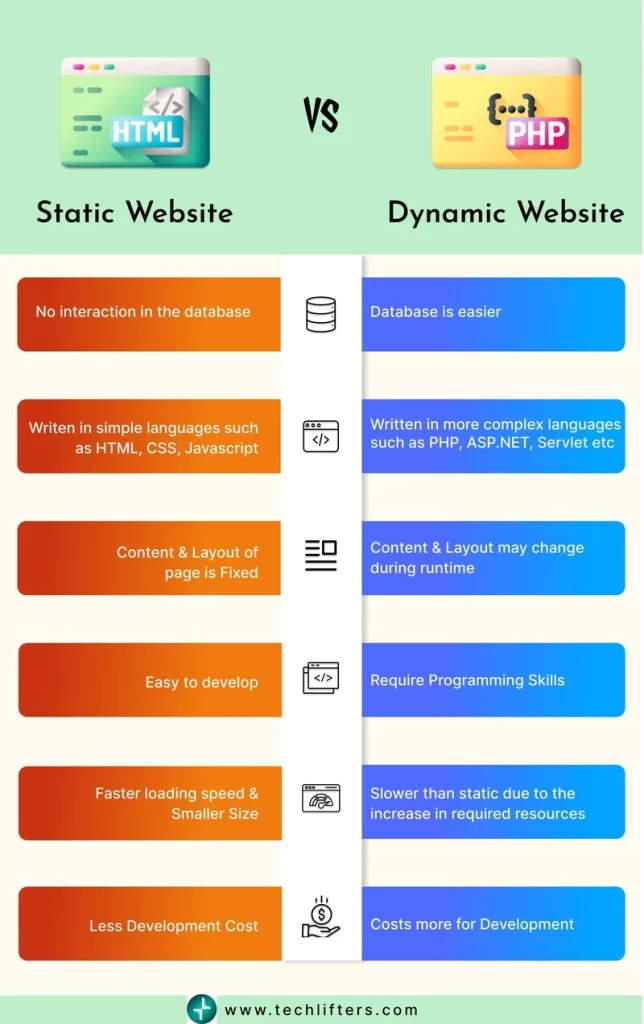
Difference between Static and Dynamic website [Infographic]
FAQs
1) What is the primary difference between static and dynamic websites?
The primary difference is in content presentation. Static websites display fixed content to all users, while dynamic websites generate content on the go, allowing personalized and interactive user experiences based on real-time data and user interactions.
2) How does website speed differs between static and dynamic sites?
Generally, static websites load faster as they present built-in content. Dynamic websites may have slightly slower loading times due to content generation processes and database queries. However, optimization techniques and caching mechanisms can be put to use to increase the speed of both static and dynamic sites.
3) Are dynamic websites more SEO-friendly than static websites?
Both static and dynamic websites can be optimized for SEO. However, dynamic sites, with regularly updated content, user engagement features, and interactive elements, often have more opportunities to incorporate relevant keywords and attract search engine attention. So, SEO success depends on implementation rather than the static or dynamic nature of the website.
4) Can a static website be converted into a dynamic one, and vice versa?
Yes, it is possible to convert a static site to a dynamic one or vice versa. The process, however, involves major changes to the site’s structure and functionality. When transitioning from static to dynamic, elements like server-side scripting, databases, and dynamic content generation need to be implemented. On the contrary, converting a dynamic site to static may involve simplifying functionalities and flattening the content structure.



Need this for your business?
Talk to our team about your project scope, timeline and budget — no obligation.
Get a Free QuoteReady to Start Your Next Project?
TechLifters helps businesses across India build high-performance websites and digital products — from design to deployment, we handle it all.